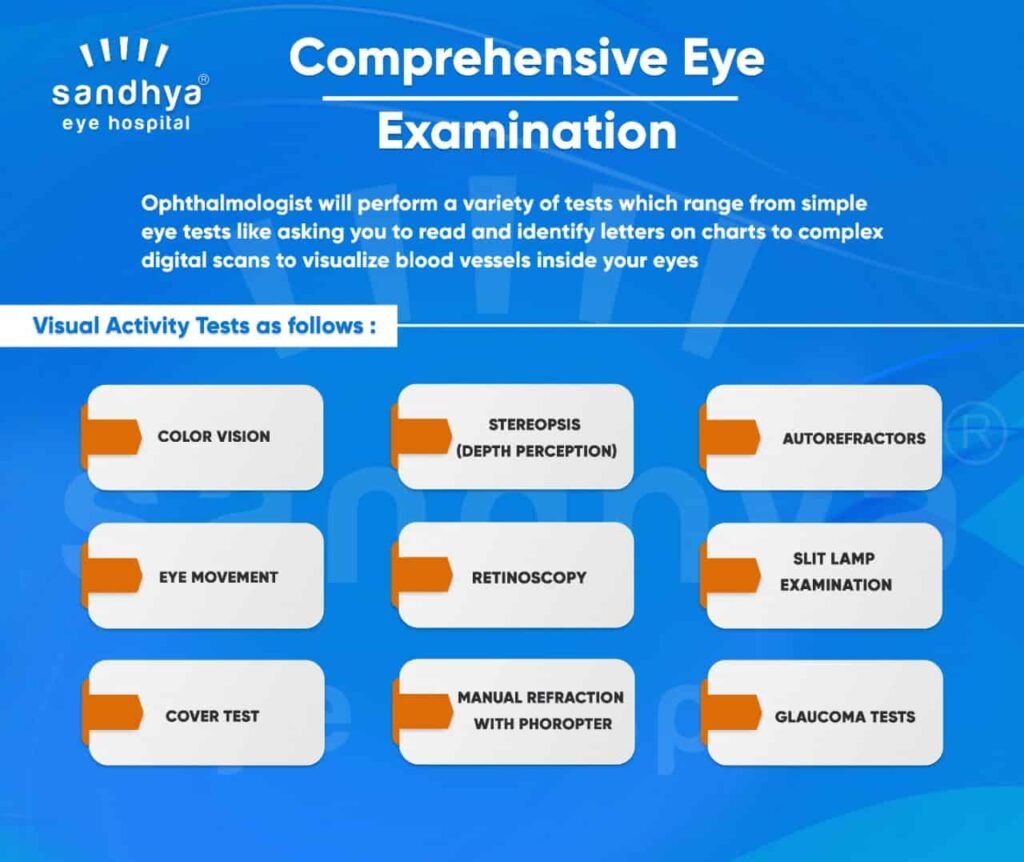
Stereopsis (Depth Perception):
Stereopsis is the ability of your eyes to co-ordinate and visualize the depth of your surroundings. The doctor will provide you with 3D glasses and ask you to read a pattern of circles and identify which of them is the closest to you.
Retinoscopy:
In this test the doctor will sit at arm’s length from you, dim the lights in the room and shine a light into your eyes from a hand-held torch like instrument. This test gives the doctor valuable information about the shape of your cornea, whether you have a cataract, and even help approximate your prescription for spectacles.
Manual refraction with phoropter:
In this test the doctor will place an instrument called Phoropter in front of your eyes and ask you to read a chart while constantly providing you various lens choices. Depending on your answers he/she will finetune the power and provide you with the clearest vision possible! This test helps determine the prescription of your spectacles. It helps correct far sightedness, short sightedness and astigmatism (a condition which occurs when your cornea is curved differently in different axis).
Autorefractors :
Your doctor can use this instrument to help accurately pinpoint the error of refraction in your eyes and help prescribe accurately powered spectacles. In this test your head is supported by a chin-rest and the instrument displays an image to you. The instrument is very efficient and determines the power of the lens required to focus light accurately on the retina (the back of the eye where perception of visual image takes place).
Slit Lamp Examination:
A slit lamp examination is basically a microscope which your ophthalmologist uses to take a closer look of your eyes. It provides high magnification. With your head supported with a chin-rest the doctor will take a look at your eyelids, cornea, iris and even the back of your eye such as the retina and the optic nerve. A powerful tool in the arsenal of the ophthalmologist, it helps diagnose many a condition like cataracts, diabetic changes and any ulcers.
Glaucoma Tests:
Using the slit lamp, your doctor will gently probe your eye to measure the pressure in your eye. Do not worry as he will give a numbing agent and you will hardly feel a scratch. As glaucoma is one of the leading causes of painless loss of vision, this test is of paramount importance.